

Exoplanet searchers exploring space for planets orbiting other stars have discovered the most youthful planet ever documented.
This planet, which is the size of Jupiter and located around 450 light-years away from Earth, is younger than the previous record holders by about 4 million years, with an age of less than 1 million years.
Astronomers verified this discovery by examining records supported by NASA from the coronagraph at the W.M. Keck Observatory, which is a tool used to block a star’s light and uncover dim objects concealed within its brightness.
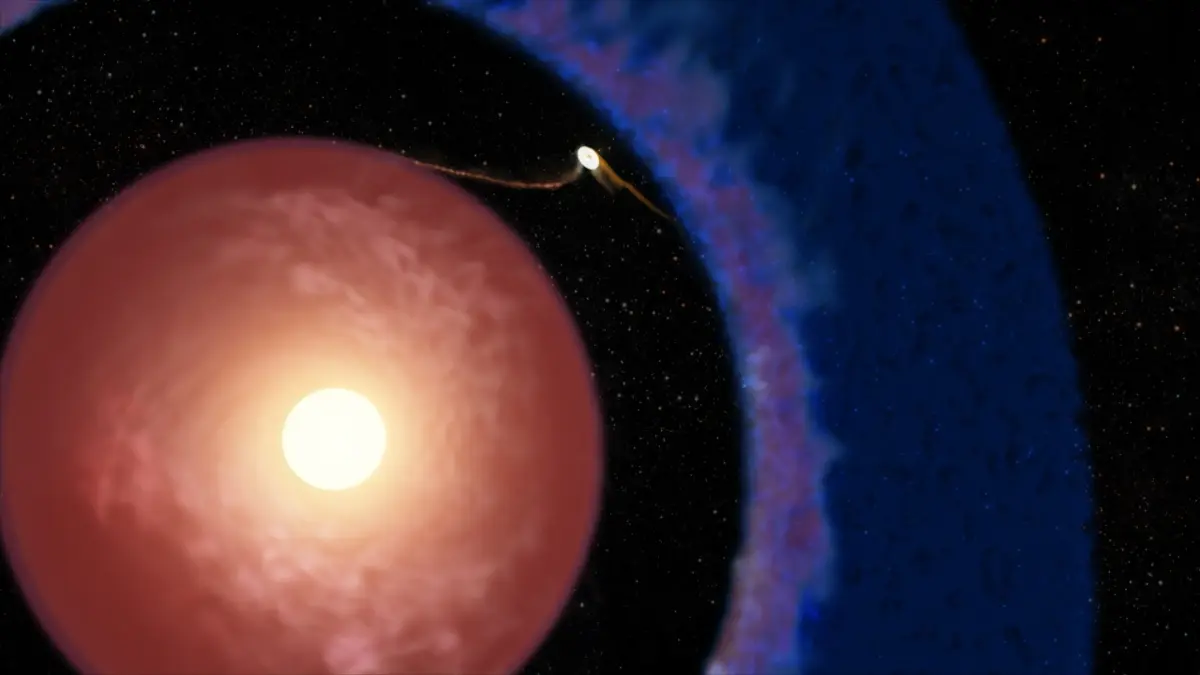
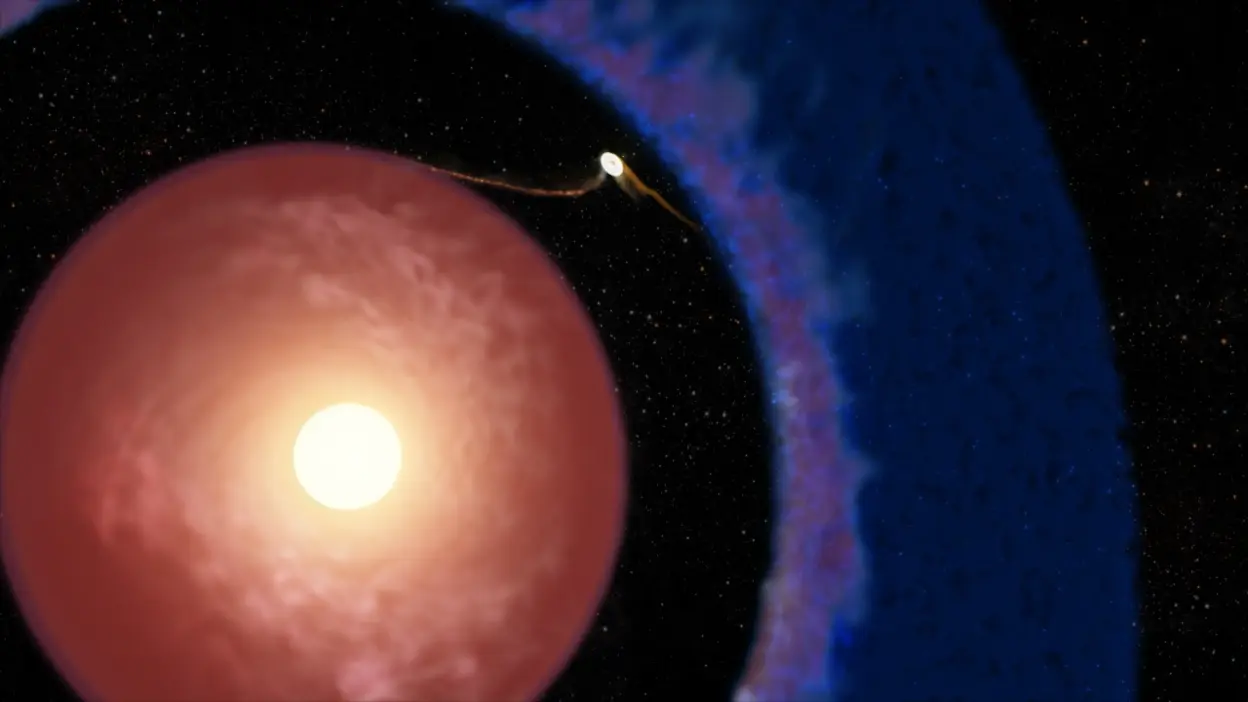
They observed a young planet nestled in a gas, dust, rock, and icy formation, which was also seen by two other observatories in 2018 and 2020. It is named Elias 2-24 b.
“The galaxy is constantly producing new stars and planets,” according to Lucas Cieza, a professor at the Instituto de Estudios Astrofísicos in Chile, who mentioned that there is a significant limitation in the detection capabilities of most telescopes, making it challenging to observe these young planets.
Researchers revisited the archives due to some unresolved matters. The Atacama Large Millimeter/submillimeter Array and the European Southern Observatory’s Very Large Telescope spotted an apparent empty space ring around the distant Elias 2-24 star, as well as a faint light point within that seemingly vacant area.
A decade ago, astronomers were skeptical when they made those observations because the discovery of Elias 2-24 b, which orbits its star at a distance 10 times greater than Jupiter’s orbit, contradicted the established theories on planet formation timescales.
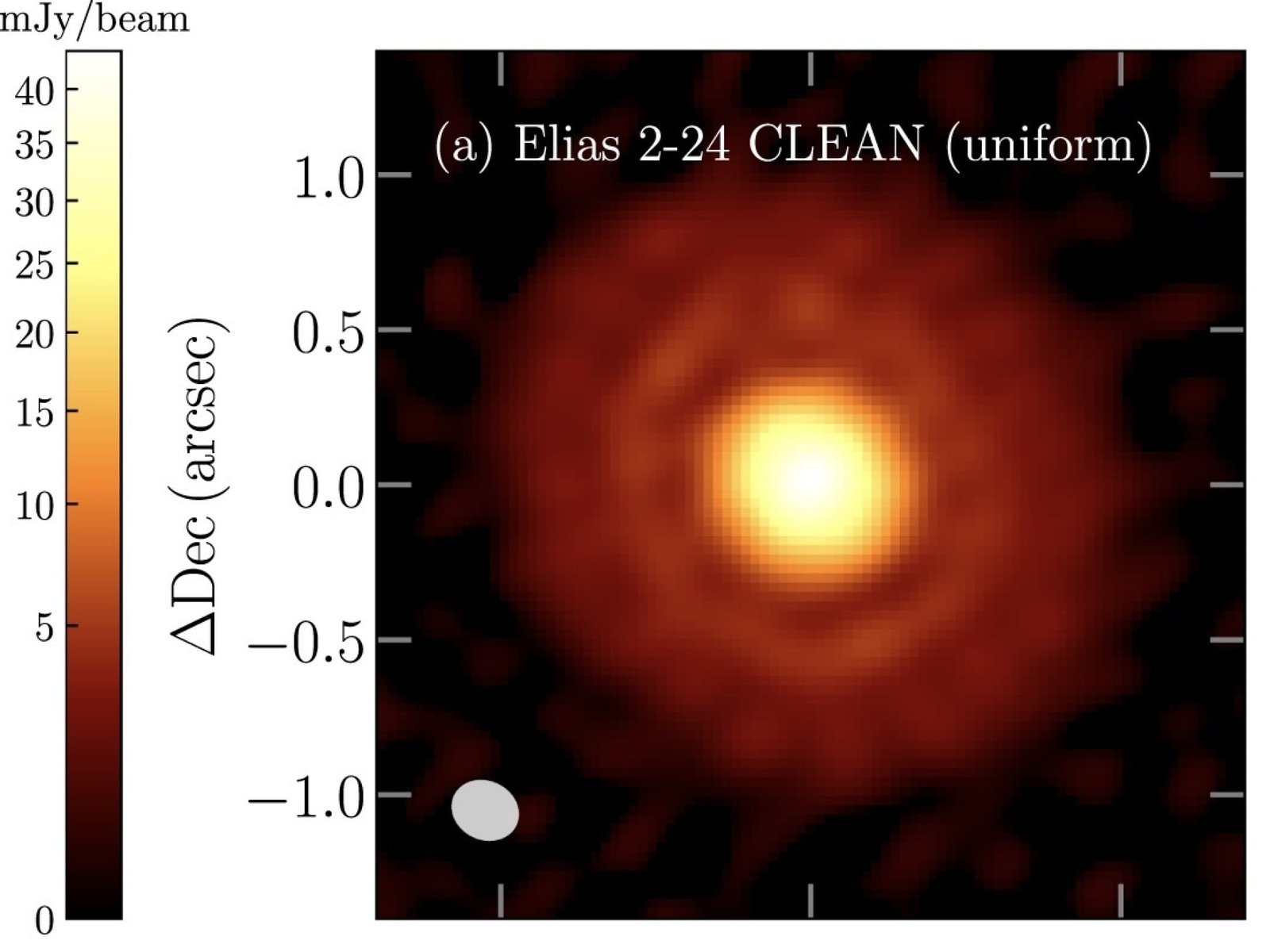
Andrea Bernardi, a doctoral student at Universidad Diego Portales in Chile, who conducted the research, mentioned that baby Elias 2-24 b was behaving like a planet and occupying the correct position. This is due to its location in a gap formed by a large object clearing gas and dust in its path as it moves in orbit. The findings of the study are published in The Astrophysical Journal Letters.
Current planet formation models are said to be missing important elements, according to researchers studying Elias 2-24 b.
Astronomers study various planets at different stages to understand planetary life cycles because they cannot observe a planet’s entire life from start to finish. However, they have limited information about baby planets as they are difficult to observe due to being covered in dust that obstructs telescopic views.
Receive science and technology updates directly in your email by subscribing to Mashable’s Light Speed newsletter or enabling Mashable push alerts.
- Scientists were aware that Mercury was contracting, but they were uncertain about the full scale of this phenomenon.
- Astronomer suggests an astonishing explanation for the absence of a super-Earth in our solar system.
- The top telescopes for observing stars and solar eclipses in 2024
- Cities of galaxies forming in the early universe are unveiled by a 3D map.
- Scientists suggest that if Venus once had a moon similar to ours, it was ultimately doomed.
New telescopes such as NASA’s Nancy Grace Roman Space Telescope are expected to simplify these observations. Roman was launched on August 30 and is currently traveling towards the second sun-Earth Lagrange point, L2, which is a million miles away, the same location where the James Webb Space Telescope is positioned. Roman is projected to unveil its initial images by January 2027 after the calibration process.
Exoplanets are difficult to see because they are much fainter than their stars. Most exoplanet findings to date have been made using indirect methods, but astronomers are optimistic that advancements in technology will allow us to capture images of Earth-sized planets near their stars.
Vanessa Bailey, NASA’s coronagraph scientist for the telescope, stated that Roman’s coronagraph is much more sophisticated than those on Hubble, Webb, and ground-based telescopes. She anticipates that the instrument will be capable of capturing images of planets as small and dim as Jupiter, a task that has proven difficult for other coronagraphs that have mostly captured larger and brighter exoplanets.
Astronomers can now use coronagraph instruments to detect planets that are significantly dimmer than their stars, with the potential to reach even fainter levels with the Roman coronagraph.
NASA is one of the subjects discussed.

Elisha Sauers, a writer for Mashable, focuses on space exploration, including NASA’s missions to the moon and Mars, interviewing astronauts and researchers, and traveling in the sky. Winner of various awards for her journalism, she has a background in covering a range of topics such as health, business, and government. Connect with her for space-related tips and story suggestions at [email protected] or 443-684-2489, and follow her on X at @elishasauers.